Saturday, May 26, 2012

FLAG STATUES IN INDIA


FLAG STATUES IN INDIA

To adorn a city by means of that oldest form of plastic art – Sculpture – is an old and time-honoured usages. It was more common in ancient Egypt and ancient Greece than anywhere else, and it originated in ancient India and other lands also independently….. Sculpture and statuary as decoration of a town came to be adopted as a universal practice in the West through the example of the Greeks and the peoples of Italy. ………The different countries of Europe began to  vie with one another in this matter, and Italy and Germany, France and Spain, and England produced some of great sculptures whose works adorning the various towns and galleries of Europe form the pride of modern European art…….

The English, after they became established in India as masters of the land, in Bengal and elsewhere, introduced, along with other things of European culture, the practice of erecting statues of eminent  persons as a most graceful form of town-decoration. ……..The  statues which were set up in India at the instance of the ruling English naturally were of Britishers eminent in the history of the establishment of English power and prestige in the country……. . So wrote  National Professor Dr Suniti Kumar Chatterji  in  an article titled ‘Calcutta Sculpture’ in November, 1925.
 
After India gained independence in 1947, many a statues have been erected  at street-corners and public places all over India immortalizing our freedom fighters and  national heroes.  Most of these  statues  have been erected in places  connected with the person celebrated, or,  where an event  that  took place glorifying the whole nation.  Several of these Statues - both in relief and round forms – have commemorated ‘Flag Events’ and ‘Flag Personalities’.
Pingali Venkayya (1876–1963), hailing from Masulipatam (Machilipatnam), founded the Indian National Flag Mission and relentlessly pursued his goal to give shape to a distinctive national flag to be accepted by all.
  In 1916 Venkayya came up with a booklet titled ‘A National Flag for India’ in which he put forth about twenty-four designs for the Indian flag.None of the flags designed by Venkayya could satisfy the then leaders who mattered.
In April 1921, prior to the Bezwada (now, Vijayawada) Congress, Mahatma Gandhi asked Venkayya to prepare a design which should contain a Charkha (spinning wheel) on a red (Hindu colour) and green (Muslim colour) background. The Charkha was placed on the flag apropos of the suggestion made by Lala Hansraj of Jullundur(Jalandhar). Later, on maturer consideration of Mahatma Gandhi, a white band, representing the other religions, was added on top of the colour green.

The Tirupur Kumaran Memorial at Tirupur,  Tamil Nadu.
 When Mahatma Gandhi was arrested on 4 January 1932 by the orders of Lord Wellington, the then British viceroy of India, a protest march was organised in Tirupur on 10  January. Tirupur Kumaran was leading the procession, holding the Swaraj flag in his hand, when police attacked Kumaran brutally. He exhibited an exemplary act of defiance against the police violence by holding the Swaraj flag up and kept chanting ‘Vande Mataram’. Next day, 11 January 1932, he breathed his last. He is known as ‘Kodi Kaatha Kumaran’—Kumaran who protected the flag.
 The Martyr's Memorial is a life-size statue of seven brave young men who sacrificed their lives in the Quit India movement (11 August 1942), to hoist the National Flag on the Secretariat building, Patna, Bihar. The  foundation stone of Martyr's Memorial was laid on August 15, 1947, by the governor of Bihar Jairam Das Daulatram. The sculptor  Deviprasad Roychoudhry built the bronze statue of the seven students with the National Flag. These statues were cast in Italy and later placed here. The seven students, whose names are engraved on the Martyrs’ Memorial in Patna were:
Umakant Prasad Sinha –         Ram Mohan Roy Seminary, class IX
Ramanand Singh –                  Ram Mohan Roy Seminary, class IX
Satish Prasad Jha –                 Patna Collegiate School, class X
Jalpati Kumar –                       Bihar National College, 2nd year
Devipada Choudhry –             Miller High English School, class IX
Rajendra Singh –                    Patna High English School, Matriculation class
Ramgovind Singh –                Punpun High English School, Matriculation class
 India Post is yet to come out with a stamp on Kanaklata Barua, the real heroine of Assam
On 20 September 1942, Kanaklata Barua, at Gohpur in Assam, a young girl then led a procession of unarmed villagers waving Purna Swaraj flags to the nearby police station.  As soon as Kanaklata unfurled the flag at the police station she and her companion Mukunda Kakati were gunned down by the Police. On the same day at Dhekiajuli police station eleven villagers were gunned down by the Police while trying to hoist the Purna Swaraj flag - three of them were teen-aged girls - Tileswari, Numali and Khahuli.
 Matangini Hazra statue, Kolkata
Matangini Hazra was known as ‘Gandhi-buri’ (literally an old female version of Gandhi). At the age of seventy-three she joined the Quit India movement, as an active volunteer. On 29 September1942, while she was leading a procession at Tamluk in Midnapore, with the Purna Swaraj flag in her hands, a shower of bullets from the police felled her. While dying, she had held the flag high and had collapsed only when she had passed the flag onto the next marcher; the flag had remained unsullied.
There is also a statue stands at the spot where Matangini Hazra was killed in Tamluk, West Bengal.

Note: The FDCs and Special Covers depicted above were all post marked at the birth/event place


Monday, May 21, 2012

INDIAN NATIONAL FLAG IN MATCHBOX LABELS


The word  Phillumeny is derived from phil  i.e. loving + lumen i.e. light.  It was coined by Marjorie S. Evans of the British Matchbox Label & Booklet Society in 1943.  Phillumeny  is the hobby of collecting different match-related items, viz., matchboxes, matchbox labels, matchbox-safes, etc.
Here are two title pages of the Match Label News, the official journal of the British Matchbox Label and Bookmatch Society.
History;
First practical matches were made in England in 1827by a druggist, John Walker. There were many trials in match making in Europe and America, before 1905, all matches were single topped; then silent ‘double dipped’ matches were developed. The first safety matches, which light only on a prepared surface, were made in Sweden in 1845. Safety matches made of cardboard or heavy paper and put in a tiny  folded packets were invented by Joshua Pusey of Pennsylvania, USA in 1892.
 A Swedish make matchbox showing Indian theme, Bankim Chandra Chatterjee and his famous composition 'Bande Mataram'.
India make matches were flourished in cottage industries since Swadeshi movement days (national awakening) competing with both imported matches, mainly from Sweden, Austria and Japan, as well as, indigenous big manufacturing houses. Many interesting images in the form of matchbox labels came out during Swadeshi movement days. I am prompted to present here a few of such matchbox labels which depicted Swadeshi (national) flags for the discerning readers.  
 The Sivaji image an example of anachronism. Sivaji Bhosle (1627-1680) just can not fly a tricolour Swadeshi flag which was developed in 1921.
The slogan reads  "Boycott Foreign Goods and use Swadeshi Products"; M.N.Mehta, Calcutta, Maunufacturer of the Best Matches


Kamaldevi Chattopadhyay (1903-1988) and Swaraj Flag

K

Some more Examples of Swaraj Flags

"Flag Salutation"; Purna Swaraj (Complete Independence)Flag created in 1931
Islamic Flags of pre-independence (prior 1947) period
Netaji Subhas Bose, Supreme Commander of the  Indian National Army (Azad Hind Fouj) and Purna Swaraj Flag.

Dawn of Independence :  The National Flag of Free India
'Father of the Nation' and National Flag


According to Flag Code of India, published by the Ministry of Home Affairs, the National Flag shall not be used for commercial purposes in violation of the Emblem and Names (Prevention of Improper Use) Act, 1950.


Monday, April 30, 2012

MAY DAY & RED FLAG


May Day or International Workers' Day 
&
The Communist Red Flag

  May Day also known as Labour Day or International Workers' Day celebrated every year on 1st May. This day is a national holiday in more than 80 countries and also celebrated unofficially in many other countries.
 In 1886 in Chicago, USA the Red flag was flown at a May Day rally for an eight-hour workday. May Day is celebrated to pay tribute to the contributions, workers have made to make the world strong and prosper. This day is dedicated to the workers for their economic and social achievements. The red flag achieved international recognition during the Soviet Revolution of 1917.  
 Red flag is a symbol of Communism. It has been associated globally with left-wing politics since the French Revolution. The flag of the Paris Commune of 1871 was red.
 "The Red Flag"
The people's flag is deepest red,
It shrouded oft our martyred dead,
And ere their limbs grew stiff and cold,
Their hearts blood dyed its every fold.
Then raise the scarlet standard high.  (chorus)
 
Within its shade we'll live and die,
Though cowards flinch and traitors sneer,
We'll keep the red flag flying here.
Look round, the Frenchman loves its blaze,
The sturdy German chants its praise,
In Moscow's vaults its hymns are sung
Chicago swells the surging throng.
 
The lyrics of the song were written by Irishman Jim Connell in 1889

At the Fifth Congress of the Communist International held in Moscow in June-July 1924, the Proletarian Organisations of Moscow presented a gold embroidered Red Flag to the Indian working classes as a token of revolutionary unity. 

 
Since the foundation in 1919 the Communist Party of India upheld the Red flag in all its political programmes. M.N. Roy born Narendra Nath Bhattacharya (1887- 1954) was an Indian nationalist revolutionary and an internationally known radical activist and political theorist. Roy was a founder of the Communist Parties in both Mexico and India and was a delegate to congresses of the Communist International. Following the rise of Joseph Stalin, Roy left the mainline communist movement to pursue an independent radical politics. In 1940 Roy was instrumental in the formation of the Radical Democratic Party, an organization in which he played a leading role for much of the decade of the 1940s. Roy later moved away from Marxism to become an exponent of the philosophy of Radical Humanism.(Source : Wikipedia)
 May 1st is historically a holiday declared in honour of workers and labour rights. Although May Day started in The United States, its observance in the US is notably absent.  In America  the first Monday in September celebrated  as “Labor Day". ( source: http://globetribune.info/2011/09/05/labor-day-vs-may-day/)
 

Friday, March 9, 2012

International Women’s Day : Honouring Women of India and their Contributions to the cause of the National Flag


IWD on March 8 is celebrated by women's groups around the world. This date is also commemorated at the United Nations. When women on all continents, often divided by national boundaries and by ethnic, linguistic, cultural, economic and political differences, come together to celebrate their Day, they can look back to a tradition that represents at least nine decades of struggle for equality, justice, peace and development.
International Women's Day is the story of ordinary women as makers of history; it is rooted in the centuries-old struggle of women to participate in society on an equal footing with men. During the French Revolution, Parisian women calling for "liberty, equality, fraternity" marched on Versailles to demand women's suffrage.
The idea of an International Women's Day first arose at the turn of the century, which in the industrialized world was a period of expansion and turbulence, booming population growth and radical ideologies. (Source http://www.un.org/ecosocdev/geninfo/women/womday97.htm)
  Flags and Stamps Honours 'Women of India' and their Contributions to the cause of the National Flag of India
Perhaps, the first serious attempt at flag-making in India came from a woman - Sister Nivedita(1867–1911) - an Irish devotee of Swami Vivekananda. Born as Margaret Elizabeth Nobel in Northern Ireland. Swami Vivekananda inspired her to come to Calcutta to spread education among Indian women. Sister Nivedita actively participated in the Swadeshi (Swadeshi standing for a political movement to attain ‘self-sufficiency’) movement and greatly contributed towards Indian nationalism.
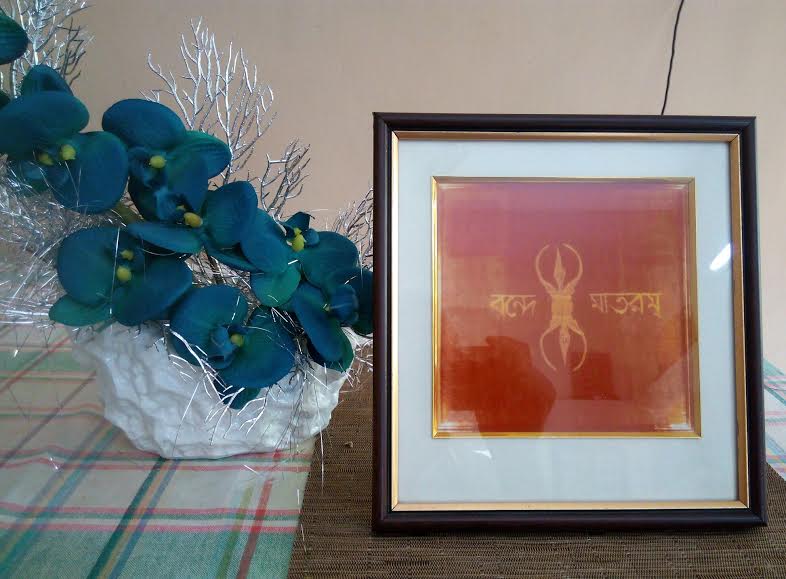
  Sister Nivedita conceived the idea of the national flag during a visit to Bodh Gaya in 1904, in the company of Jagadish Chandra Bose and Rabindranath Tagore. She was inspired by the vajra (thunderbolt) sign, a symbol of Buddha, that implies ‘the selfless man’. It was the weapon of Lord Indra and is a symbol of strength. It is also associated with the Goddess Durga. According to legend, vajra was created from the bones of Rishi Dadhichi. It is a symbol of supreme sacrifice.
 A strikingly similar flag to the 1906 Calcutta flag (Bande Mataram flag), with minor deviations, was waved by Bhikaiji Rustom Cama on 22 August 1907 at the Second International Socialist Congress in Stuttgart, Germany. Waving the flag Madame Cama declared,
This flag is of Indian independence. Behold it is born. It is already sanctioned by the blood of martyred Indian youths. I call upon you, gentlemen, to rise and salute this flag of Indian Independence. In the name of this flag, I appeal to lovers of freedom all over the world to cooperate with this flag in freeing one-fifth of the human race.
 Madame Cama wrote in a leaflet titled ‘Bande Mataram – A Message to the People of India’ (1908) ;
This flag of Bande Mataram, which I wave before you, was made for me by a noble selfless young patriot [Hemchandra Kanungo], who is now standing at the bar of the so-called court of justice in our country. What a mockery to talk of justice and jury! 
 After World War I she had to remain in exile and was allowed to return to India only when her health deteriorated in 1935. Madame Cama quietly passed away in Bombay (Mumbai) on 16 August 1936, unsung and unmourned. The undaunted lady wrote for her tombstone in French and Gujarati, ‘Resistance to tyranny is obedience to God’—her most befitting epitaph. 
 Madam Cama’s flag was clandestinely brought  into India and kept it at a secret location in Bombay. In 1937. G.V. Ketkar, grandson of Bal Gangadhar Tilak and former editor of  the Kesari and Tarun Bharat retrieved the original flag from the secret place receiving tips from Indulal Yagnik of Gujarat. The framed flag is preserved for public viewing in the Tilak Museum of Maratha and Kesari Library in Pune.
India’s first female prime minister, Mrs Indira Gandhi, paid her tribute in her ‘Foreword’ to the book Madame Cama – Mother of Indian Revolution by Dr Panchanan Saha: ‘We remember specially her bold action and pioneering work to popularise our national flag. It is the tricolour she unfurled which was adopted with some alternation by our freedom movement.’
 During Quit India movement on 9 August 1942, following the arrest of most of the prominent leaders, Aruna Asaf Ali (Ganguli), came forward and unfurled the Purna Swaraj flag at the Gowalia Tank Maidan to announce the commencement of the Quit India movement. The raising of the flag by Aruna Asaf Ali provided the spark that ignited the Quit India movement. She became an iconic figure for thousands of youths who rose to emulate her. Forty-five years later, on 9 August 1987, Aruna Asaf Ali reenacted the flag hoisting ceremony at the same venue in Bombay, renamed August Kranti Maidan to celebrate the fortieth anniversary of India’s Independence.
 On 10 September 1942, at Barangabari under Gohpur Police Station in the district of Darrang (at present Sonitpur) a young girl named Kanaklata Barua from the village of Barangabri led a procession of unarmed villagers under the Purna Swaraj flag. As soon as Kanaklata unfurled the flag she and her companion Mukunda Kakati were gunned down by the armed police. Their heroic sacrifice is still remembered with pride. On the same day at Dhekiajuli Police Station eleven unarmed villagers were gunned down by the armed police while trying to hoist the tri-color at the police station. Three teenage girls called Tileswari, Numali and Khahuli killed in this incident are especially commemorated by the locals. 
Kanaklata Barua has not yet been philatelically honoured by India post
 Matangini Hazra was known as ‘Gandhi-buri’(literally an old female version of Gandhi). At the age of seventy-three she joined the Quit India movement, as an active volunteer. On 29 September1942, while she was leading a procession at Tamluk in Midnapore, with the Purna Swaraj flag in her hands, a shower of bullets from the police felled her. While dying, she had held the flag high and had collapsed only when she had passed the flag onto the next marcher; the flag had remained unsullied.
 The sample of the ‘Tiranga with the emblem of Asoka Chakra’ which was presented by Pandit Jawaharlal Nehru in the Constituent Assembly on 22 July 1947, for adoption as Free India’s National Flag, that, so proudly we hail today, was prepared by Mrs Badr-ud-Din Tyabjee (her husband was the joint secretary in the Constituent Assembly and grandson of the great Tayabjee who was the president of the All India Congress party in 1887). 
Badr-ud-Din Tyabjee has not yet been philatelically honoured by India post
 Mrs Sarojini Naidu, the ‘Bulbule Hind’, was given the honour of making the final speech in the Constituent Assembly on 22 July 1947. And she concluded her long emotional speech by saying;
… Many of my friends have spoken of this Flag with the poetry of their own hearts.  I as a poet and as a woman, I am speaking prose to you when I say that we women stand for the unity of India. Remember this Flag there is no prince and there is no peasant, there is no rich and there is no poor. There is no privilege there is only duty and responsibility and sacrifice. Whether we be Hindus or Muslims, Christians, Sikhs or Zorostrians and others, our Mother India has one undivided heart and one indivisible spirit. Men and women of reborn India rise and salute this Flag.  I bid you, rise and salute the Flag.
 At the stroke of midnight on 15 August 1947, free India’s national flag was hoisted atop the Council House, renamed Parliament Bhavan in New Delhi. The flown flag was presented by Mrs Hansa Mehta representing the Flag Presentation Committee comprising of all the women members of the Constituent Assembly, as a gift from the women of India.
 Born in Surat, she was  a freedom fighter who made it her mission to free India. She actively took part in the freedom struggle and had to suffer imprisonment many a times.  Hansa Mehta was the first woman to be appointed Vice-Chancellor of a co-educational University in India. 
 Hansa Mehta has not yet been philatelically honoured by India post